Product Overview
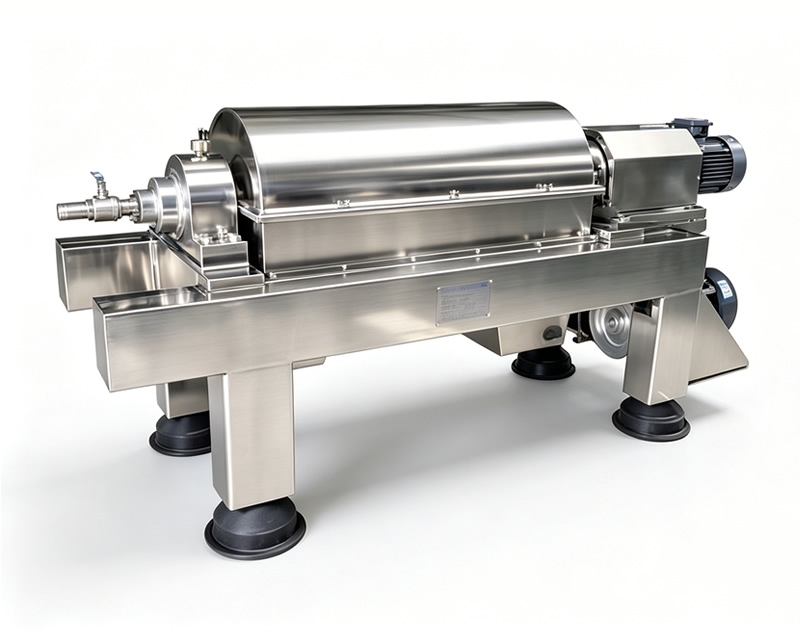
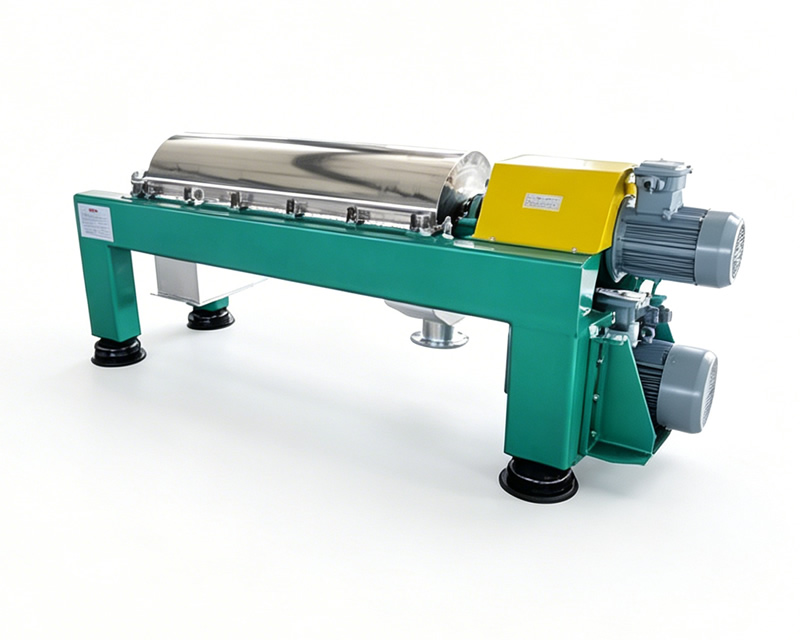
As a continuously operating horizontal spiral discharge sedimentation equipment, the decanter centrifuge operates on the principle that the bowl and the screw conveyor rotate in the same direction at high speed with a certain differential speed.
Materials are continuously fed into the inner cylinder of the feed screw through the feed pipe, and then accelerated into the bowl. Under the action of strong centrifugal force, heavier solid phase particles deposit on the inner wall of the bowl to form a sediment layer. The screw conveyor continuously pushes the deposited solid phase through the drying zone at the small end of the bowl for further dewatering, and then discharges it out of the machine through the slag discharge port. Lighter liquid phase forms an inner liquid ring, flows out of the bowl continuously through the overflow port at the large end, and is discharged through the liquid outlet.
The whole machine can complete continuous feeding, separation and discharging under full-speed operation. It has the characteristics of compact structure, continuous operation, stable running, strong adaptability, large production capacity, convenient maintenance and low energy consumption.
Equipment Features
- Fully automatic continuous operation Realizes fully automatic continuous production including continuous feeding, continuous separation and continuous discharging under full-speed operation, which greatly improves production efficiency and reduces manual labor intensity.
- High-efficiency centrifugal separation Generates strong centrifugal force through high-speed rotation, achieving efficient solid-liquid separation. It performs well even for fine particles and materials with low concentration, delivering reliable and stable separation effect.
- Compact structure & stable operation Integrated horizontal structure with compact layout and small floor space. The whole machine runs smoothly with low vibration and low noise, adapting to long-term continuous industrial production.
- Strong material adaptability Suitable for suspension materials with solid particle size of 0.005–10mm, concentration of 2–40% and temperature ≤100℃. It can be flexibly configured to meet different separation requirements of various materials.
- Low energy consumption & easy maintenance Reasonable structural design with low operation energy consumption. Daily maintenance and component replacement are convenient, ensuring low long-term operation cost.
- Customizable configuration options Multiple configurations are available including different bowl diameters, length-diameter ratios, construction materials, wear-resistant linings, screw cone angles and electric control cabinet configurations, to fully match different process requirements.
Working Principle
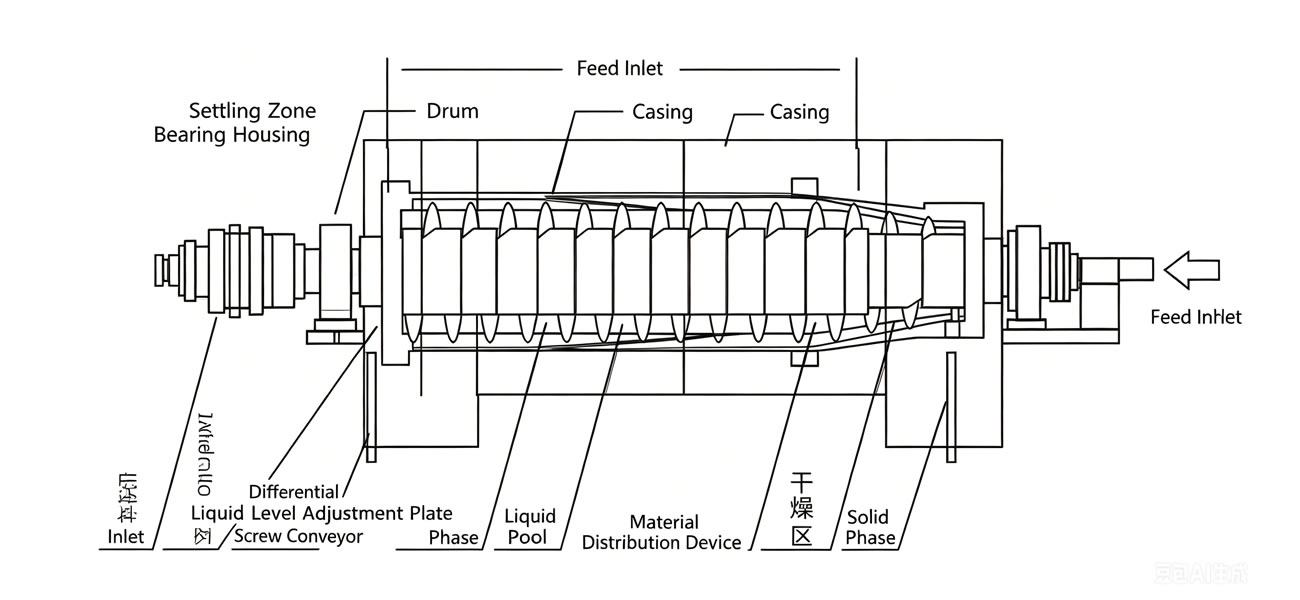
Driven by the motor, the bowl and the screw conveyor rotate in the same direction at high speed, maintaining a fixed differential speed through the differential mechanism.
The material to be treated is continuously fed into the feed screw inner cylinder via the feed pipe, and is uniformly accelerated into the rotating bowl. Under the action of strong centrifugal force field, heavier solid phase particles are rapidly deposited on the inner wall of the bowl to form a sediment layer.
The screw conveyor, rotating at a slightly lower speed than the bowl, continuously scrapes and pushes the deposited solid sediment toward the conical small end of the bowl. The solid phase is further dewatered in the drying zone before being discharged through the slag outlet at the small end.
Meanwhile, the lighter clear liquid phase forms an inner liquid ring layer, flows out continuously through the overflow port at the large end of the bowl, and is collected and discharged through the liquid outlet channel. The whole separation process runs continuously and automatically under full-speed operation.
Equipment Selection Guide
- Bowl diameter options: Various bowl diameters are available to meet different material processing capacity requirements.
- Length-diameter ratio options: Different length-diameter ratios are provided to match different slag discharge performance and separation effect requirements.
- Material options: Different construction materials are available to meet corrosion resistance requirements for different material properties.
- Wear-resistant options: Different wear-resistant materials and linings are available to meet wear resistance requirements for different abrasive materials.
- Screw cone angle options: Different screw cone angles are designed to meet different moisture content requirements of discharged solid phase.
- Electric control options: Different electric control cabinet configurations are available to meet different safety and automation requirements of customers.
Technical Parameters
LW355×1600
| Item | Specification |
|---|---|
| Bowl Diameter | 355 mm |
| Bowl Length | 1600 mm |
| Rotation Speed | 3800 rpm |
| Separation Factor | 2868 |
| Processing Capacity | 1 – 20 m³/h |
| Main Motor Power | 15 – 18.5 kW |
| Weight | 1850 kg |
| Overall Dimensions | 3490 × 860 × 1200 mm |
LW400×1800
| Item | Specification |
|---|---|
| Bowl Diameter | 400 mm |
| Bowl Length | 1800 mm |
| Rotation Speed | 3650 rpm |
| Separation Factor | 3000 |
| Processing Capacity | 1 – 25 m³/h |
| Main Motor Power | 15 – 22 kW |
| Weight | 2500 kg |
| Overall Dimensions | 3890 × 1020 × 1205 mm |
LW450×2000
| Item | Specification |
|---|---|
| Bowl Diameter | 450 mm |
| Bowl Length | 2000 mm |
| Rotation Speed | 3450 rpm |
| Separation Factor | 3000 |
| Processing Capacity | 3 – 35 m³/h |
| Main Motor Power | 22 – 37 kW |
| Weight | 3000 kg |
| Overall Dimensions | 4297 × 1080 × 1385 mm |
LW500×2000
| Item | Specification |
|---|---|
| Bowl Diameter | 500 mm |
| Bowl Length | 2000 mm |
| Rotation Speed | 3000 rpm |
| Separation Factor | 2500 |
| Processing Capacity | 5 – 45 m³/h |
| Main Motor Power | 30 – 37 kW |
| Weight | 3800 kg |
| Overall Dimensions | 4330 × 1140 × 1470 mm |
Data is for reference only. Specifications can be fully customized according to actual material properties and process requirements.
Application Fields
- Pharmaceutical & plant extraction: Separation of traditional Chinese medicine extracts and other plant extraction liquids; separation of antibiotic fermentation broth mycelium; separation of blood products.
- Food & beverage industry: Juice clarification and pulp fiber separation; separation of soybean, peanut, wheat and other plant & animal proteins; separation of fish meal, fish meat and surimi; separation of distiller’s grains; washing, separation and dehydration of various plant starches.
- Oil & fat industry: Separation and purification of various animal oils, vegetable oils and mineral oils.
- Chemical & dye industry: Separation of humic acid; separation of dyes and pigments; particle size classification of various granular materials.
- Environmental protection industry: Sludge dewatering, wastewater treatment and solid-liquid separation in municipal and industrial environmental protection projects.
- Other industries: Solid-liquid separation, classification and dehydration processes in chemical, mining, metallurgy and other industrial sectors.